In today’s high‑cost, labor‑constrained environment, restaurants need technology that works where service happens. Mobile POS brings ordering and payment to the table, helping operators increase table turns, reduce errors and do more with less staff.
How restaurant operators struggle to maintain guest expectations
Customer expectations are rising with the pace of fast-moving technology. Guests expect speed, accuracy and seamless service. With so much competition among restaurants, waiting too long for a server or dealing with the server taking down the wrong order is no longer acceptable.
Fortunately, there’s good news: tableside ordering and payment technology is redefining how guests order, pay and interact with staff. A handheld point-of-sale system—a small but powerful innovation—has been helping restaurants overcome labor shortages, boost revenue and elevate guest satisfaction for years. We’ll delve into why brands consider buying them, what a mobile POS is and how it can improve operations in your business.
The top challenges currently facing restaurant operators
- Rising operational costs. Restaurants are struggling with steep increases in food, labor, rent, utilities and supply costs. Labor expenses alone have surged due to minimum wage hikes and competitive pay demands. To survive, restaurants must find a way to be as efficient as possible with their labor.
- Staff and workforce management. Finding and retaining qualified staff remains a top concern. High turnover, wage pressures and employee expectations are driving restaurants to invest in technology that enables their staff to increase their tips and cover more sections easily.
- Supply chain volatility. Global disruptions continue to affect ingredient availability and pricing. Restaurants need to adapt on the fly by making changes in the kitchen that are easily communicated to servers seamlessly while they are on the floor.
Enter mobile POS: the game changer that addresses these concerns.
What is a mobile POS?
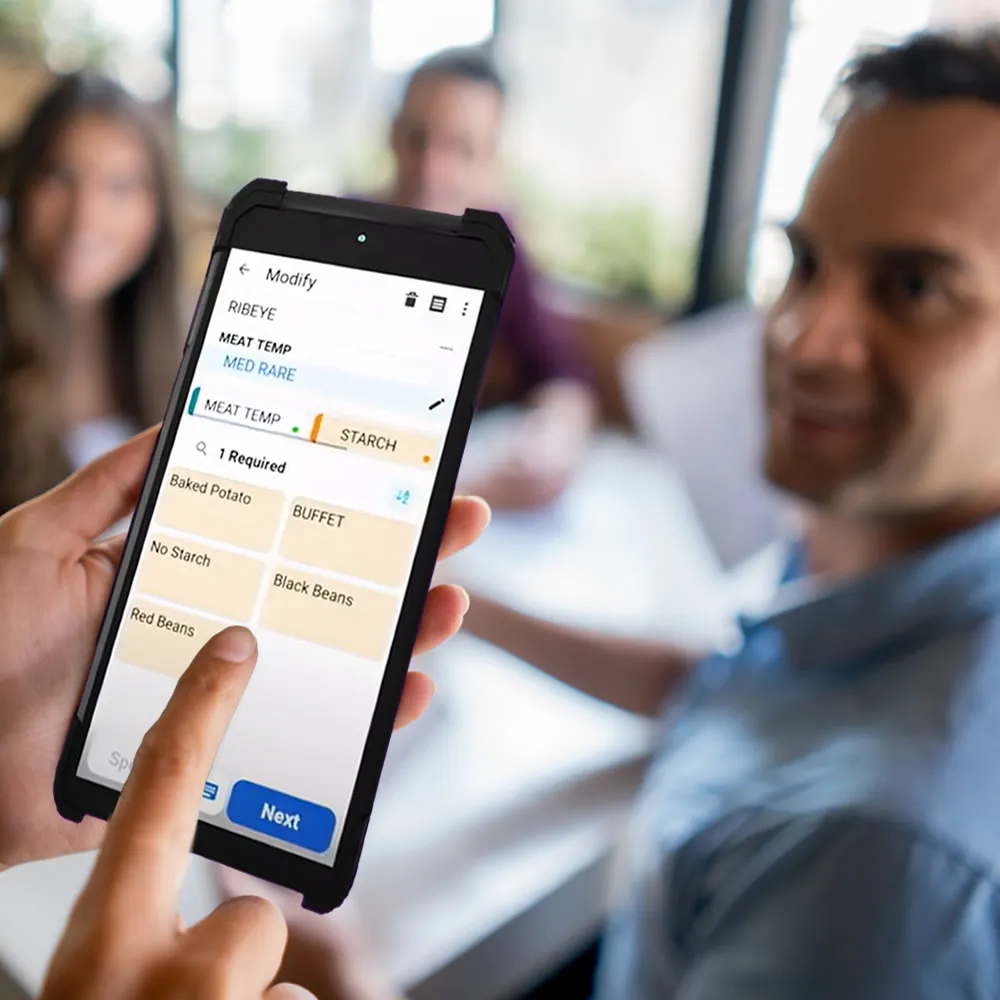
Mobile POS is a handheld point‑of‑sale system that enables servers to take orders and process payments directly at the table, improving service speed, order accuracy, and labor efficiency. They’re typically lightweight and fit into server’s hands. Instead of writing orders down with pen and paper, walking to a fixed terminal and inputting the orders, a mobile POS means servers can input orders while they’re at the table. As soon as the order is complete, it goes to the kitchen.
Mobile POS applications can also manage payments directly at the table or anywhere else in the restaurant. This eliminates the need to run back and forth to a fixed terminal, saving time and reducing errors.
How mobile POS is used across the restaurant industry
Mobile POS use is growing across full-service restaurants, hospitality venues and event-driven environments. Having the mobility and flexibility to take orders next to the guests means faster table turns and improved labor-to-sales ratios—which means increased revenue per shift. For curbside restaurant, servers walk to the cars and take orders.
No matter the usage, it supports operational flexibility across different types of restaurant landscapes—and the results show its effectiveness.
How mobile POS is used across the restaurant industry
Mobile POS use is growing across full-service restaurants, hospitality venues and event-driven environments. Having the mobility and flexibility to take orders next to the guests means faster table turns and improved labor-to-sales ratios—which means increased revenue per shift. For curbside restaurant, servers walk to the cars and take orders.
No matter the usage, it supports operational flexibility across different types of restaurant landscapes—and the results show its effectiveness.
How a mobile POS improves restaurant operations
- Speed of service. Orders go straight to the kitchen, reducing prep time and increasing table turns. Leveraging handheld POS, for events, drove faster payment processing and increased speed of service resulting in a 30% increase in table turns for The Trade Hotel. Faster table turns meant more revenue. You can read more of their story here.
- Order accuracy: Real-time order entry directly in front of the guest minimizes mistakes and food waste.
- Labor efficiency: Servers can manage more tables, reducing staffing needs.
As a result of these benefits, 68% of operators now use handheld POS for tableside or curbside service. You can find more insights about this trend here.
How mobile POS future-proofs your restaurant
As consumer expectations evolve, restaurants must adapt. Mobile POS is more than just a convenience; it’s a competitive advantage, and soon, it’ll be an expectation. Nevertheless, investing in technology can feel like a big step. If you’re unsure about buying, watch out for these five signs our clients noticed before they decided to upgrade.
By investing in mobile POS solutions, operators can:
- Improve guest satisfaction
- Reduce operational costs
- Capture valuable customer data
- Keep their staff happy
Tableside tech is essential to staying agile and keeping up with guests’ expectations. With mobile POS systems, restaurants can thrive in today’s challenging environment and build a foundation for long-term success.
To learn more about how much a mobile POS can help a brand? We worked with Wai-Kai to get a mobile POS for their operations, and they reported a 13% reduction in labor-to-sales ratio. They also reported faster table turns after rolling out our mobile POS. You can read about their full story here.